
Beyond the bonanza: AI as a science discovery engine – Maike Sonnewald – Tuesday 16th of December 2025 – 11:00 CTE

Room: 24-25 108 Campus Pierre et Marie Curie

Onlinehttps://inria.webex.com/inria/j.php?MTID=mde59a1a59c9154e7c9aa68e57f692569

Abstract:
Artificial Intelligence promises to revolutionize how we understand complex systems like Earth’s climate. From predicting ocean currents to identifying patterns too complicated for the human eye, the promise of AI is incredible. However, validation remains a key concern.

In this talk, I explore how AI can advance our scientific enterprise in improving climate models and serving as a tool to gain new knowledge, when used carefully. Through examples from ocean and atmosphere dynamics, we will examine how machine learning can uncover governing equations, identify dominant processes, and reveal new patterns in ocean circulation. Using both supervised and unsupervised approaches, I’ll show how we can move beyond black-box predictions toward AI that learns in ways consistent with physics and meaningfully extends scientific understanding.

I have two goals: to highlight where AI can yield transformative insights for climate science, and to show how we can build the trust, transparency, and semantic grounding to distinguish genuine discoveries from illusions.

Biography:

Maike Sonnewald is an Assistant Professor in the Computer Science Department and a CAMPOS scholar. In 2016 Prof. Sonnewald received her PhD in Complex Systems Simulation through the National Oceanography Center at the University of Southampton, UK. Her doctoral work was followed by a postdoctoral position at the Department of Earth, Atmosphere and Planetary Sciences in the Massachusetts Institute of Technology. She then joined Princeton University as an Associate Research Scholar. She has held visiting positions at various institutions in the US and Europe. Current affiliations include Affiliate Assistant Prof at the University of Washington School of Oceanography, Affiliate Reseacher at NOAA-GFDL and Visiting Scientist at Princeton. 
Large-scale deep-learning for weather and climate prediction – Laure Reynauld, 11th of June 2025, 11:00 CET

Abstract: A new paradigm for weather and climate prediction has emerged recently: data-driven prediction models have become competitive with standard physics-based models on many aspects, thanks to an accurate encoding of the data distribution. Most models have been developed for task-specific purposes and are trained on a single type of data (such as the ERA5 reanalysis). The next challenge to expand the capabilities of data-driven modeling is to fully exploit the vast range of atmospheric observations, characterized by spatio-temporal variations and heterogeneous outputs (point or spatial time series, vertical profiles, vertically integrated data, … ). This naturally leads to the development of foundation models that learn a task-agnostic representation of the atmosphere. An overview of the most advanced models will be presented, as well as early results for integrating heterogeneous data sources.

Bio: A graduate of the National School of Meteorology and holder of a PhD from the University of Toulouse 3, Laure Raynaud is a researcher in numerical weather prediction at the National Center for Meteorological Research (CNRM/MétéoFrance). Her research focuses mainly on data assimilation and probabilistic forecasting. She regularly collaborates with several applied fields (agriculture, energy, transportation). Her recent work explores artificial intelligence methods and their use in the computation and operational application of weather forecasts. She holds a chair at the Toulouse Artificial Intelligence Institute (ANITI).

AI4Climate seminar: Machine Learning for Climate Change and Environmental Sustainability – Claire Monteleoni – 6th of February 11:00CET

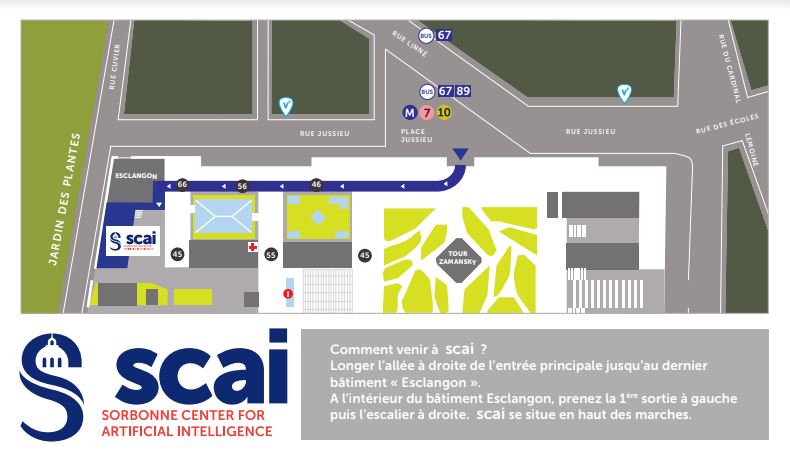
The seminar is on February the 6th, at 11:00 (CET) remotely and in person. The in-person meeting will be held in the SCAI conference room (map at the end of the post).

If you like to attend online, the link for the zoom is here: https://zoom.us/j/98108885974

Abstract:
Despite the scientific consensus on climate change, drastic uncertainties remain. Crucial questions about regional climate trends, changes in extreme events, such as heat waves and mega-storms, and understanding how climate varied in the distant past, must be answered in order to improve predictions, assess impacts and vulnerability, and inform mitigation and sustainable adaptation strategies. Machine learning can help answer such questions and shed light on climate change. I will give an overview of our climate informatics research, focusing on challenges in learning from spatiotemporal data, along with semi- and unsupervised deep learning approaches to studying rare and extreme events, and precipitation and temperature downscaling.

Bio:
Claire Monteleoni is a Choose France Chair in AI and Directrice de Recherche at INRIA Paris, an Associate Professor in the Department of Computer Science at the University of Colorado Boulder, and the founding Editor in Chief of Environmental Data Science, a Cambridge University Press journal, launched in December 2020. She joined INRIA in 2023 and has previously held positions at University of Paris-Saclay, CNRS, George Washington University, and Columbia University. She completed her PhD and Masters in Computer Science at MIT and was a postdoc at UC San Diego. She holds a Bachelor’s in Earth and Planetary Sciences from Harvard. Her research on machine learning for the study of climate change helped launch the interdisciplinary field of Climate Informatics. She co-founded the International Conference on Climate Informatics, which turns 12 years old in 2023, and has attracted climate scientists and data scientists from over 20 countries and 30 U.S. states. She gave an invited tutorial: Climate Change: Challenges for Machine Learning, at NeurIPS 2014. She currently serves on the NSF Advisory Committee for Environmental Research and Education.